
Wall Street Claims Territory on Blockchains
Software is disrupting banking and financial services. For a fraction of a cent, stablecoins facilitate transactions at the speed of the internet...

Bitcoin: From "Digital Gold" to Consumer Applications
From the streets of El Salvador to the boardrooms of Wall Street, shifting market dynamics have propelled Bitcoin from the fringes of the internet to the center of global financial discourse. The return of Tether (USDt) on Bitcoin signals its evolution from the “digital gold” and “store-of-value” narrative to a payment network powering the tokenization of financial assets. Bitcoin holds a dominant position in the digital asset sector, reflected by a 60% dominance, and market capitalization of...

Governance 2030: What if Government Functioned as a DAO?


Wall Street Claims Territory on Blockchains
Software is disrupting banking and financial services. For a fraction of a cent, stablecoins facilitate transactions at the speed of the internet...

Bitcoin: From "Digital Gold" to Consumer Applications
From the streets of El Salvador to the boardrooms of Wall Street, shifting market dynamics have propelled Bitcoin from the fringes of the internet to the center of global financial discourse. The return of Tether (USDt) on Bitcoin signals its evolution from the “digital gold” and “store-of-value” narrative to a payment network powering the tokenization of financial assets. Bitcoin holds a dominant position in the digital asset sector, reflected by a 60% dominance, and market capitalization of...

Governance 2030: What if Government Functioned as a DAO?
Share Dialog
A new way to transfer value across the internet - x402 is creating financial rails for autonomous AI agents to become independent economic participants. As an open protocol for internet-native payments, x402 enables AI agents to autonomously discover, access, and pay for services - without intermediaries or human intervention. Created by Coinbase, x402 embeds payments directly into HTTP, unlocking machine-to-machine commerce at scale, and positioning AI agents to become the internet's largest economic force.
The autonomous AI agent economy is projected to reach $30 trillion by 2030. Since launch in May 2025 the x402 ecosystem has processed over 159.42 million transactions worth $43.06 million between 407,920 buyers and 81,000 sellers. X402 enables instant low-cost payments for digital services. Subscription based monetization models are replaced with pay-per-use API queries, micropayments for businesses, and on-demand content where consumers pay per article, dataset, or video. No manual checkout flows required. Payments are no longer an application on the web, rather a native network built directly into the HTTP infrastructure itself. A payment rail for the internet without high friction, minimums, and percentage fees involved with credit cards.

Share Dialog
A new way to transfer value across the internet - x402 is creating financial rails for autonomous AI agents to become independent economic participants. As an open protocol for internet-native payments, x402 enables AI agents to autonomously discover, access, and pay for services - without intermediaries or human intervention. Created by Coinbase, x402 embeds payments directly into HTTP, unlocking machine-to-machine commerce at scale, and positioning AI agents to become the internet's largest economic force.
The autonomous AI agent economy is projected to reach $30 trillion by 2030. Since launch in May 2025 the x402 ecosystem has processed over 159.42 million transactions worth $43.06 million between 407,920 buyers and 81,000 sellers. X402 enables instant low-cost payments for digital services. Subscription based monetization models are replaced with pay-per-use API queries, micropayments for businesses, and on-demand content where consumers pay per article, dataset, or video. No manual checkout flows required. Payments are no longer an application on the web, rather a native network built directly into the HTTP infrastructure itself. A payment rail for the internet without high friction, minimums, and percentage fees involved with credit cards.

X402 revives a three-decade old vision of the web - an open internet-native payment protocol. HTTP 402 "Payment Required”. Dormant since 1996 the designers of HTTP anticipated that the web would require a protocol-level mechanism for value exchange. However, due to the high friction of legacy payments and lack of agreement on standardization, the 402-status code was reserved as a placeholder. While legacy payment infrastructure made automated micropayments an economic impossibility, the confluence of AI, blockchain, and stablecoins have produced the ideal payment rails for agentic commerce. Small-value transactions that were previously impractical now work on internet scale.

X402 is a trojan horse for mainstream adoption of stablecoins - a market worth over $293.44 billion with 223.44 million holders, and $9.77 trillion in transfer volume the past 30 days. Blockchain experienced its “broadband moment” earlier this decade with the arrival of Ethereum Layer-2 (L2) networks – scaling solutions for reducing transaction costs to a fraction of a cent while enabling internet native micropayments. High throughput L2s leveraging stablecoins allow AI agents to move value at the speed of the internet. Ethereum L2 networks have increased from 27 in 2022 to 154 in 2025, securing over $40.89 billion in value with Arbitrum One, Base, and Optimism comprising over $16 billion, 11 billion, and $1.93 billion respectively. L2s enable enterprises to design blockchain environments customized to their compliance, performance, and privacy requirements without building from scratch. Transactions executed on L2s are settled on Ethereum – a credibly neutral public infrastructure serving as a global settlement layer for agentic commerce and finance.
Agentic commerce will increase the speed of transactions, collapsing the time it takes for product and service discovery. Leveraging Agentic Payments Protocol (AP2) and x402 extension, Google and Coinbase created a proof-of-concept demo for Lowe's Innovation Lab. With simple text prompts and pictures, an AI agent can diagnose a DIY project, research, inventory, shop, and check-out on behalf of a customer with stablecoins. X402 is a neutral internet standard anyone can build-on and integrate - blockchain agnostic, supporting EVM-compatible chains and Solana. The ability to integrate x402 payments into Farcaster Mini Apps, showcases a future where AI commerce is built directly into social media experiences. Allowing creators and merchants to accept USDC payments without a customer leaving the application or managing complex payment flows. In practice, when a client requests data or a service from an x402-enabled HTTP server, the server responds with a '402 Payment Required' status including payment instructions specifying a supported token like USDC or another stablecoin. Once the client completes the payment, the transaction is verified, and the requested resource is delivered.
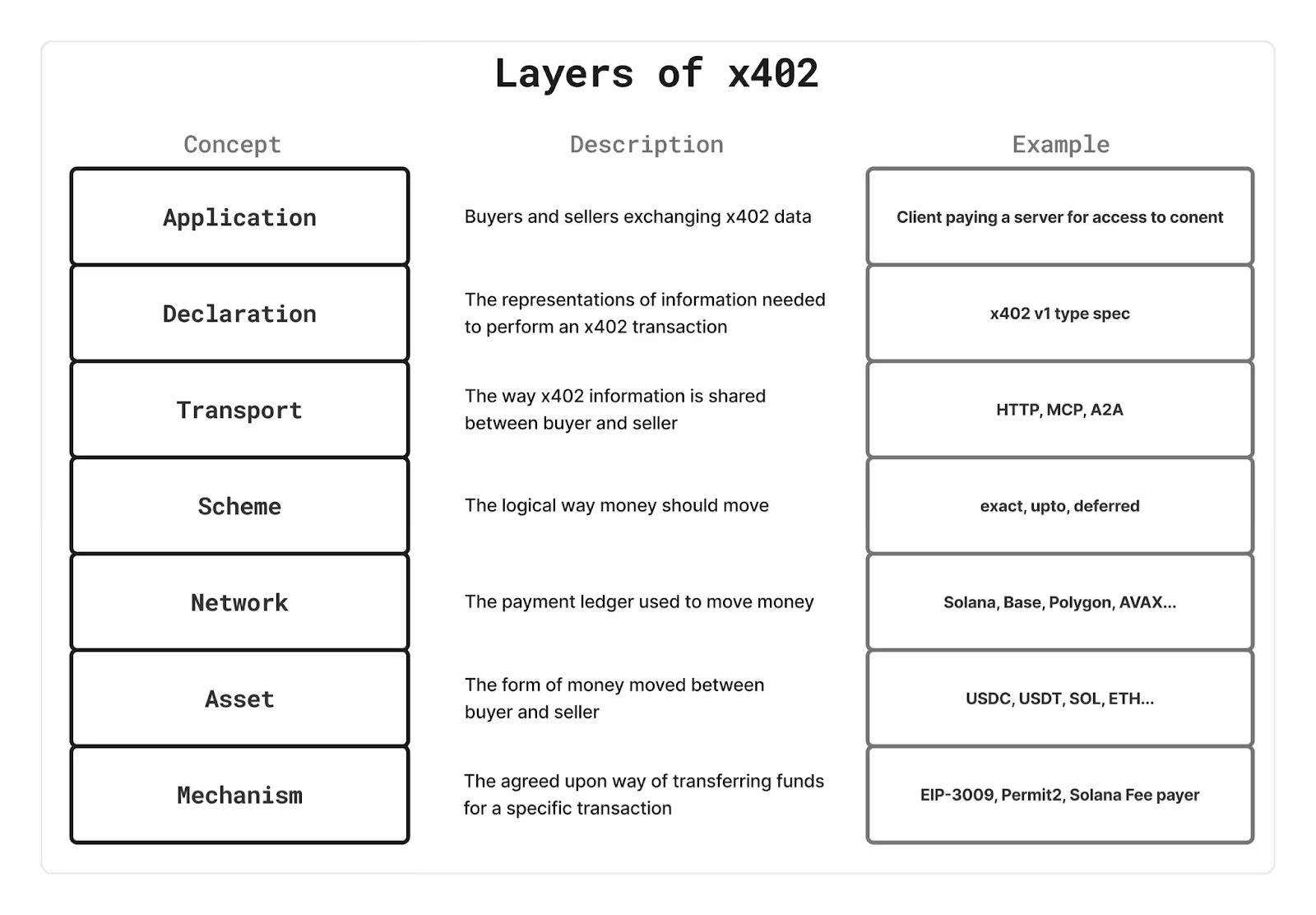
AI is beginning to permeate every layer of the tech stack, from hardware to software and user-experience. Agentic onchain wallets represent the next evolution – a shift away from unfriendly interfaces toward self-custodial wallets like MetaMask and Phantom that integrate with LLMs to translate your written or spoken requests into actions (e.g., “Phantom pay Veronica $100 in USDC”). But this is only the beginning, as AI simplifies how humans interact with blockchain, it is also paving the way for machines to transact entirely on their own. A “smart” world of machine-to-machine commerce, where autonomous systems and IoT devices transact seamlessly without human intervention. Picture an electric self-driving semi-truck pulling into an automated charging station, replenishing its battery, and settling payment in USDC over the blockchain - all on its own. What once filled the pages of science fiction is fast becoming reality.
X402 represents more than a technical standard - it marks the fulfillment of a vision the web's architects embedded into HTTP three decades ago, now realized by the convergence of AI, blockchain, and stablecoins. By transforming payments from a bolted-on application into native internet infrastructure, x402 removes the friction that has long constrained digital commerce to human mediated transactions with minimum thresholds and percentage-based fees. In this way, x402 may prove to be the bridge that carries blockchain technology from early adopters into the fabric of everyday commerce, powered not by human enthusiasm but by machines that simply need it to work.
Disclaimer: This material is for informational purposes only and not intended to provide financial, investment, legal, or tax advice. Information is strictly educational and not an endorsement or solicitation to buy or sell any assets or to participate in any investment or trading strategy. No representation or warranty is made, express or implied, as to the accuracy and completeness of the information. Links to third-party websites in the material do not imply endorsement. Please consult with your own accountant, attorney, investment or other certified professional advisor in relation to any investment decision.
X402 revives a three-decade old vision of the web - an open internet-native payment protocol. HTTP 402 "Payment Required”. Dormant since 1996 the designers of HTTP anticipated that the web would require a protocol-level mechanism for value exchange. However, due to the high friction of legacy payments and lack of agreement on standardization, the 402-status code was reserved as a placeholder. While legacy payment infrastructure made automated micropayments an economic impossibility, the confluence of AI, blockchain, and stablecoins have produced the ideal payment rails for agentic commerce. Small-value transactions that were previously impractical now work on internet scale.

X402 is a trojan horse for mainstream adoption of stablecoins - a market worth over $293.44 billion with 223.44 million holders, and $9.77 trillion in transfer volume the past 30 days. Blockchain experienced its “broadband moment” earlier this decade with the arrival of Ethereum Layer-2 (L2) networks – scaling solutions for reducing transaction costs to a fraction of a cent while enabling internet native micropayments. High throughput L2s leveraging stablecoins allow AI agents to move value at the speed of the internet. Ethereum L2 networks have increased from 27 in 2022 to 154 in 2025, securing over $40.89 billion in value with Arbitrum One, Base, and Optimism comprising over $16 billion, 11 billion, and $1.93 billion respectively. L2s enable enterprises to design blockchain environments customized to their compliance, performance, and privacy requirements without building from scratch. Transactions executed on L2s are settled on Ethereum – a credibly neutral public infrastructure serving as a global settlement layer for agentic commerce and finance.
Agentic commerce will increase the speed of transactions, collapsing the time it takes for product and service discovery. Leveraging Agentic Payments Protocol (AP2) and x402 extension, Google and Coinbase created a proof-of-concept demo for Lowe's Innovation Lab. With simple text prompts and pictures, an AI agent can diagnose a DIY project, research, inventory, shop, and check-out on behalf of a customer with stablecoins. X402 is a neutral internet standard anyone can build-on and integrate - blockchain agnostic, supporting EVM-compatible chains and Solana. The ability to integrate x402 payments into Farcaster Mini Apps, showcases a future where AI commerce is built directly into social media experiences. Allowing creators and merchants to accept USDC payments without a customer leaving the application or managing complex payment flows. In practice, when a client requests data or a service from an x402-enabled HTTP server, the server responds with a '402 Payment Required' status including payment instructions specifying a supported token like USDC or another stablecoin. Once the client completes the payment, the transaction is verified, and the requested resource is delivered.

AI is beginning to permeate every layer of the tech stack, from hardware to software and user-experience. Agentic onchain wallets represent the next evolution – a shift away from unfriendly interfaces toward self-custodial wallets like MetaMask and Phantom that integrate with LLMs to translate your written or spoken requests into actions (e.g., “Phantom pay Veronica $100 in USDC”). But this is only the beginning, as AI simplifies how humans interact with blockchain, it is also paving the way for machines to transact entirely on their own. A “smart” world of machine-to-machine commerce, where autonomous systems and IoT devices transact seamlessly without human intervention. Picture an electric self-driving semi-truck pulling into an automated charging station, replenishing its battery, and settling payment in USDC over the blockchain - all on its own. What once filled the pages of science fiction is fast becoming reality.
X402 represents more than a technical standard - it marks the fulfillment of a vision the web's architects embedded into HTTP three decades ago, now realized by the convergence of AI, blockchain, and stablecoins. By transforming payments from a bolted-on application into native internet infrastructure, x402 removes the friction that has long constrained digital commerce to human mediated transactions with minimum thresholds and percentage-based fees. In this way, x402 may prove to be the bridge that carries blockchain technology from early adopters into the fabric of everyday commerce, powered not by human enthusiasm but by machines that simply need it to work.
Disclaimer: This material is for informational purposes only and not intended to provide financial, investment, legal, or tax advice. Information is strictly educational and not an endorsement or solicitation to buy or sell any assets or to participate in any investment or trading strategy. No representation or warranty is made, express or implied, as to the accuracy and completeness of the information. Links to third-party websites in the material do not imply endorsement. Please consult with your own accountant, attorney, investment or other certified professional advisor in relation to any investment decision.
No comments yet